Why Is The Skin's Role As A "barrier" Bad For Hair Loss Drugs?

Gone

Established Member
My Regimen
Reaction score
96
Shortening this post.

Why are drugs that cannot penetrate scalp skin considered inviable, when the drug can still move through follicular openings to the hair follicles? What prevents people from using a drug/vehicle that is capable of follicular delivery but not through the scalp skin?
 
Last edited:

Swoop

Senior Member
My Regimen
Reaction score
1,332
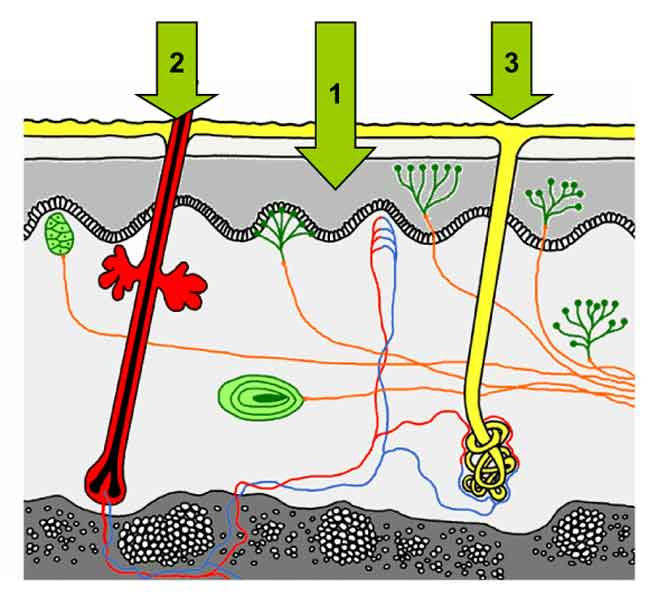
There are three general routes that make drug penetration happen through the skin. Look at the picture below.


image3.png


1. Is just through the stratum corneum. Many small molecule drugs can do this given that they are low in molecular weight. The more lipophilic they are, the better. They will disperse into the dermis after. An example is topical minoxidil.

2. Is the follicular delivery route you are talking about. This can only happen if the particle size is small enough. Think of formulations that have nanosomes/liposomes. Now a normal minoxidil formulation won't be able to go through the hair follicle openings. But you can load minoxidil into a nanosome formulation so that the particle size would be small enough to be able to go through the follicular route.
 

Gone

Established Member
My Regimen
Reaction score
96
Yup, I'm familiar with them, except for the sweat gland one. I learned it as intercellular, transcellular, and follicular; you've probably seen me post about related topics before.

I think you'll understand what I'm getting at, which is that a drug that does not take path #1 (inter/transcellular) but does take path #2 would be better targeted to hair follicles.

So it confused me that much of vehicle preparation also seems to be focused on getting the drug through path #1, which does not lead to hair follicles. This would be closer to a systemic treatment.

The answer is apparently, as you said, that particles must be small enough to enter the follicular route. But please enlighten me as to how placing a molecule in a capsule (liposome, microparticles, etc.) makes the combined volume of the drug/capsule smaller than the drug molecule alone? A drug molecule incapsulated in a nanoparticle must be larger than just the molecule itself.

So I have a few questions to ask:

1. What is preventing a drug, without being encapsulated in any vehicle at all, from entering the hair follicles if the drug molecule, by itself, is small enough? Is this because the drug would not be able to enter the hair cells without a vehicle, or it isn't bioavailable? Is it accurate or inaccurate that the drug would enter the follicular route easily, but then be unable to enter the target cells? Is a vehicle always necessary, even in the case of topical delivery?

2. Would decreasing the size of the drug vehicle particles, such as that they are then small enough to enter route #2, resultingly make the drug vehicle particles small enough that they would also penetrate through route #1? Could there be a size threshold at which a drug in its vehicle could move through route #2 and not route #1?

Hair follicles are, if I'm correct, larger openings than the spaces between cells, and provide an easier route than moving through every cell membrane in the skin to get to the lower hair follicles. Shouldn't it be relatively easy to find a drug size that moves through follicular openings but not skin cells?
 

Gone

Established Member
My Regimen
Reaction score
96
Here's an example of what I see as a misunderstanding of drug delivery, based on the common habit of hair loss drug users applying ethanol as a method to increase skin penetration.

"The present study revealed no penetration-enhancing effect of ethanol, neither for the suspension and nor for the gel formulations. Even though ethanol is described as classical penetration enhancer for intercellular penetration, explained with the extraction of lipids from the stratum corneum, this might not be applicable to follicular penetration processes."

http://images.biomedsearch.com/2431...017600&Signature=J+KkaHUiNeUNqW5PBy0U4IypuzM=

It really does almost nothing for follicular drug delivery, which should be the goal.
 

hairblues

Banned
My Regimen
Reaction score
8,251
@Swoop

I looked up spironolactone molecular mass and it came up as 416.574 g/mol

does that penetrate?

here is estrodial 272.382 g/mol
 

rclark

Banned
My Regimen
Reaction score
1,773
There are three general routes that make drug penetration happen through the skin. Look at the picture below.


image3.png


1. Is just through the stratum corneum. Many small molecule drugs can do this given that they are low in molecular weight. The more lipophilic they are, the better. They will disperse into the dermis after. An example is topical minoxidil.

2. Is the follicular delivery route you are talking about. This can only happen if the particle size is small enough. Think of formulations that have nanosomes/liposomes. Now a normal minoxidil formulation won't be able to go through the hair follicle openings. But you can load minoxidil into a nanosome formulation so that the particle size would be small enough to be able to go through the follicular route.

Does the latter have any hope/or any scientific discoveries that full under number two?
 

abcdefg

Senior Member
Reaction score
782
This topic is actually a pretty important one. Things like topical spironolactone and numerous other topicals could all be failing because they just arent delivered right. The different layers of skin themselves like the dermal layer is a complicated 3d matrix of skin so the exact properties of that I dont know, but its not an easy thing to get consistent penetration to where it needs to be, and keep there long enough to get used.
 

mr_robot

Experienced Member
Reaction score
385
I remember menthol being mentioned as a penetration enhancer when I was doing my research on peppermint oil.
 

kj6723

Senior Member
My Regimen
Reaction score
3,986
Good thread. This is why I've added peppermint oil and tretinoin to my regimen, because success stories on here lead me to believe increased penetration has the potential to take minoxidil effectiveness to another level
 

Gone

Established Member
My Regimen
Reaction score
96
I mean, you guys are kind of on to something, but remember that skin penetration doesn't necessarily mean the drug takes the route you want it to.

I was trying to condense my truck load of questions for Swoop into a few that would be simple to answer, but I think I've actually found the answer. I asked these questions because I thought I might be missing something, but I came to a different conclusion.

Why are drugs that cannot penetrate scalp skin considered inviable, when the drug can still move through follicular openings to the hair follicles? What prevents people from using a drug/vehicle that is capable of follicular delivery but not through the scalp skin?

Addressing both points: Absolutely nothing. It is due to misinformation, lack of promoted knowledge on this issue, and the fault of drug manufacturers for not preparing their chemicals properly and tailoring it to the medical indication.

The literature states that the particle size which can both fit through the pilosebacious route, while preferring this route to other methods of transport through the skin, is around 7um (micrometers).

Ethanol, which I had referenced before, is both helpful for follicular delivery because it strips sebum from the hair follicle, allowing more various drugs to enter easily, while also being detrimental to follicular delivery, because it opens up pores in the rest of the skin it's applied to.

But I mean, much more is known on how to delivery drugs properly than I thought. I'm not missing something, it really is just done improperly.
 
Top