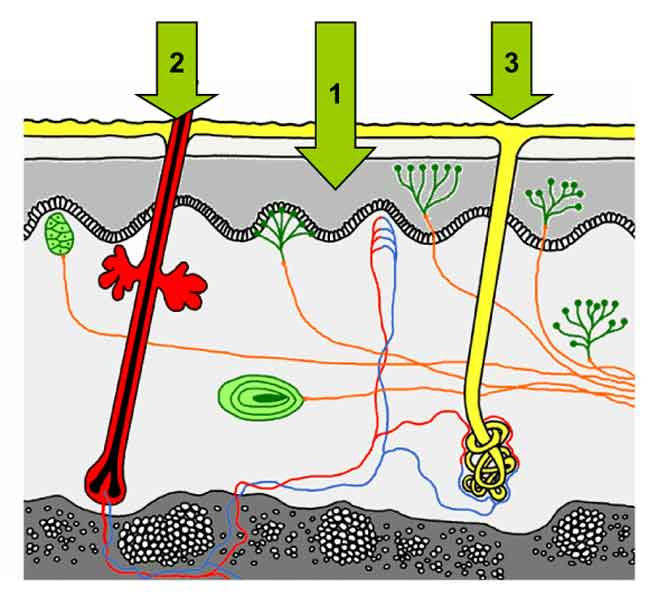
I mean, you guys are kind of on to something, but remember that skin penetration doesn't necessarily mean the drug takes the route you want it to.
I was trying to condense my truck load of questions for Swoop into a few that would be simple to answer, but I think I've actually found the answer. I asked these questions because I thought I might be missing something, but I came to a different conclusion.
Why are drugs that cannot penetrate scalp skin considered inviable, when the drug can still move through follicular openings to the hair follicles? What prevents people from using a drug/vehicle that is capable of follicular delivery but not through the scalp skin?
Addressing both points: Absolutely nothing. It is due to misinformation, lack of promoted knowledge on this issue, and the fault of drug manufacturers for not preparing their chemicals properly and tailoring it to the medical indication.
The literature states that the particle size which can both fit through the pilosebacious route, while preferring this route to other methods of transport through the skin, is around 7um (micrometers).
Ethanol, which I had referenced before, is both helpful for follicular delivery because it strips sebum from the hair follicle, allowing more various drugs to enter easily, while also being detrimental to follicular delivery, because it opens up pores in the rest of the skin it's applied to.
But I mean, much more is known on how to delivery drugs properly than I thought. I'm not missing something, it really is just done improperly.