
The androgenic alopecia is a dropout of a hair, on one of the following reasons:
1. The redundant presence of a man's sexual hormone of dihydrotestosterone (DHT);
2. Hypersensitivity of hair follicles to DHT;
3. Hyperactivity of ferment a 5-alpha-reductases which transmutes testosterone in DHT.


Picture 1. Man's type of a baldness.
On some estimates, the androgenic alopecia makes up to 95 % of all cases of a baldness at men and women. At men the androgenic alopecia will usually start in front from a line of propagation of a hair and advances to a vertex (though other alternatives are possible also) (Picture 1).


Picture 2. Female type of a baldness.
At women progressing thinning out and a thinning of a hair practically on all head, especially in the field of a vertex is observed (Picture 2).
Still Hippokrates has paid attention, that eunuchs do not grow bald. Later same condition scored Aristotle. In 40th years of XX century doctor James Gamilton wrote, that the reason of a baldness can be excess of man's sexual hormones in a combination to genetical predisposition.
As a matter of fact, it is impossible to tell, that sexual hormones kill or reinforce propagation of a hair in general. The result of activity of androgens or estrogens on a hair will be defined by presence of a special receptor on a surface of crates of a hair follicle. The receptor reminds the button, and a hormone - a dactyl which pushes this button. The result of pressure of the button is predetermined by mechanisms which are present at a follicle.
All question in what wires to these buttons are brought. So, estrogens boost propagation of a hair on a head and kill propagation of a hair on the face and a body. Androgens boost propagation of a beard and whiskers, propagation of a hair on some sections of a body and can kill propagation of a hair on a head. Certainly, has put here not so much in androgens, how much in what follicles in what areas are had. If on a head there will be follicles which have DHT-dependent "buttons" of a stopping of propagation in reply to excess of androgens there will be a dropout of a hair. If we shall transplant on a head follicles from area of whiskers or beards excess of androgens, on the contrary, will call propagation of a hair on a head. By the way, one of methods of controlling with a baldness at an androgenic alopecia is transplantation of DHT-activated follicles on sections of a baldness.
The women, suffering an androgenic alopecia, usually have also other attributes of a hyperandrogenic syndrome - redundant propagation of a hair on the face, and also acne and seborrhea. However virilization, that is occurrence of man's features of a constitution of a body, is observed seldom. Almost always both men, and the women, suffering an androgenic alopecia, have the normal or inappreciablly increased level of androgens in a blood. It is considered, that a principal cause of dropout of a hair at an androgenic alopecia is or pinch of activity the 5-alpha-reductases, or sensitization of receptors to DHT.
Ferment a 5-alpha-reductases is present at an organism in two views: the type 1 contains in a prostate gland at men, type 2 - in sebaceous glands and hair follicles. The problem of ferment - to transfer the testosterone circulating in a blood, in the active shape - dihydrotestosterone (DHT). It would Seem, what for to hair bulbuses to transmute testosterone in DHT if a hair from it fall out? However there is the deep biological sense. A hair are the important sexual attribute, and they need to know, whether they should grow in the yielded section of a body. And it depends on that to that posesses the yielded body - to the man or the woman. For example, the follicles had in the field of a chin, will react on DHT plusly, as a beard - a man's attribute. And here excess of estrogens will force the same follicles to stop production of a hair. As the long hair are an attribute of women, instead of men the hair follicles had on a head, are boosted by estrogens and kill with androgens. If any follicle becomes too sensitive to androgens it killing activity can become for it excessive.
DHT manifests the killing activity, affecting on a growth phase of a hair so the hair prematurely enters into a resting phase. In general, each follicle can be in three various phases of life cycle - anagen, catagen and the telogen (Picture 3.) Anagen is a time when a hair follicle yields a hair. In a stage anagen which lasts some years, usually there are 85 % of hair follicles. Catagen - a time of degradation of a follicle. Propagation of a hair is shut down, and the root of a hair gets the characteristic shape of a bulbus. This phase prolongs some weeks. In phase telogen to a phase of a hair separates from a root and sluggishly advances to a surface of a leather. In a stage of a telogen there are approximately 15 % of a hair. This hair fall out at combing and washing of a head. Normal losses of a hair makes 70-80 in day.
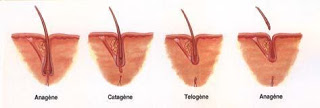
Picture 3. Growth phases of a hair.
In a picture you see, that from a concluding phase of propagation (Anagen) the hair transfers in following stage Catagen. Thus the interior segment separates from a papilla. Further the bulbus of a hair is tightened up to a level of a muscle-эректора (Telogen). Then propagation of a hair is shut down, begins formation of a new hair and, in phase Anagen which has stepped again, the growing hair "pushes out" a bulbus of an aged hair.
DHT in some follicles is the reason of cutting of a growth phase. These follicles do not attain the maximal quantity and consequently start to yield a thin and feeble hair. At a microscopic study the reduced, obsolete follicles which are the characteristic attribute of an androgenic alopecia are visible. As the relation between follicles in a stage anagen and in a stage of a telogen is displaced aside based follicles, on a head there are many follicles which simultaneously kick a hair fibril. As a result the thinning and impairment of a hair are terminated by their progressing dropout. In hair bulbuses other ferment - an aromatase which transmutes DHT revertively into testosterone and estrogens contains. He reduces level DHT in hair follicles and is the antagonist the 5-alpha-reductases. At women in follicles of the frontal area of a scalp the content of an aromatase in some times is more, than at men. It diffuse and less expressed character of an androgenic alopecia at women speaks. Besides at women in the field of a nucha DHT-steady follicles which do not shorten a growth phase at action DHT place. Therefore thinning out of a hair at women usually does not affect bottom of a nucha. At men also the bottom of a nucha is the most inconvertible to a baldness. From this area take follicles for transplantations.
from http://propecia-hairloss.blogspot.com/2 ... dness.html
Sorry for my english. I shall be grateful, if will help to correct errors in this article.
1. The redundant presence of a man's sexual hormone of dihydrotestosterone (DHT);
2. Hypersensitivity of hair follicles to DHT;
3. Hyperactivity of ferment a 5-alpha-reductases which transmutes testosterone in DHT.
Picture 1. Man's type of a baldness.
On some estimates, the androgenic alopecia makes up to 95 % of all cases of a baldness at men and women. At men the androgenic alopecia will usually start in front from a line of propagation of a hair and advances to a vertex (though other alternatives are possible also) (Picture 1).
Picture 2. Female type of a baldness.
At women progressing thinning out and a thinning of a hair practically on all head, especially in the field of a vertex is observed (Picture 2).
Still Hippokrates has paid attention, that eunuchs do not grow bald. Later same condition scored Aristotle. In 40th years of XX century doctor James Gamilton wrote, that the reason of a baldness can be excess of man's sexual hormones in a combination to genetical predisposition.
As a matter of fact, it is impossible to tell, that sexual hormones kill or reinforce propagation of a hair in general. The result of activity of androgens or estrogens on a hair will be defined by presence of a special receptor on a surface of crates of a hair follicle. The receptor reminds the button, and a hormone - a dactyl which pushes this button. The result of pressure of the button is predetermined by mechanisms which are present at a follicle.
All question in what wires to these buttons are brought. So, estrogens boost propagation of a hair on a head and kill propagation of a hair on the face and a body. Androgens boost propagation of a beard and whiskers, propagation of a hair on some sections of a body and can kill propagation of a hair on a head. Certainly, has put here not so much in androgens, how much in what follicles in what areas are had. If on a head there will be follicles which have DHT-dependent "buttons" of a stopping of propagation in reply to excess of androgens there will be a dropout of a hair. If we shall transplant on a head follicles from area of whiskers or beards excess of androgens, on the contrary, will call propagation of a hair on a head. By the way, one of methods of controlling with a baldness at an androgenic alopecia is transplantation of DHT-activated follicles on sections of a baldness.
The women, suffering an androgenic alopecia, usually have also other attributes of a hyperandrogenic syndrome - redundant propagation of a hair on the face, and also acne and seborrhea. However virilization, that is occurrence of man's features of a constitution of a body, is observed seldom. Almost always both men, and the women, suffering an androgenic alopecia, have the normal or inappreciablly increased level of androgens in a blood. It is considered, that a principal cause of dropout of a hair at an androgenic alopecia is or pinch of activity the 5-alpha-reductases, or sensitization of receptors to DHT.
Ferment a 5-alpha-reductases is present at an organism in two views: the type 1 contains in a prostate gland at men, type 2 - in sebaceous glands and hair follicles. The problem of ferment - to transfer the testosterone circulating in a blood, in the active shape - dihydrotestosterone (DHT). It would Seem, what for to hair bulbuses to transmute testosterone in DHT if a hair from it fall out? However there is the deep biological sense. A hair are the important sexual attribute, and they need to know, whether they should grow in the yielded section of a body. And it depends on that to that posesses the yielded body - to the man or the woman. For example, the follicles had in the field of a chin, will react on DHT plusly, as a beard - a man's attribute. And here excess of estrogens will force the same follicles to stop production of a hair. As the long hair are an attribute of women, instead of men the hair follicles had on a head, are boosted by estrogens and kill with androgens. If any follicle becomes too sensitive to androgens it killing activity can become for it excessive.
DHT manifests the killing activity, affecting on a growth phase of a hair so the hair prematurely enters into a resting phase. In general, each follicle can be in three various phases of life cycle - anagen, catagen and the telogen (Picture 3.) Anagen is a time when a hair follicle yields a hair. In a stage anagen which lasts some years, usually there are 85 % of hair follicles. Catagen - a time of degradation of a follicle. Propagation of a hair is shut down, and the root of a hair gets the characteristic shape of a bulbus. This phase prolongs some weeks. In phase telogen to a phase of a hair separates from a root and sluggishly advances to a surface of a leather. In a stage of a telogen there are approximately 15 % of a hair. This hair fall out at combing and washing of a head. Normal losses of a hair makes 70-80 in day.
Picture 3. Growth phases of a hair.
In a picture you see, that from a concluding phase of propagation (Anagen) the hair transfers in following stage Catagen. Thus the interior segment separates from a papilla. Further the bulbus of a hair is tightened up to a level of a muscle-эректора (Telogen). Then propagation of a hair is shut down, begins formation of a new hair and, in phase Anagen which has stepped again, the growing hair "pushes out" a bulbus of an aged hair.
DHT in some follicles is the reason of cutting of a growth phase. These follicles do not attain the maximal quantity and consequently start to yield a thin and feeble hair. At a microscopic study the reduced, obsolete follicles which are the characteristic attribute of an androgenic alopecia are visible. As the relation between follicles in a stage anagen and in a stage of a telogen is displaced aside based follicles, on a head there are many follicles which simultaneously kick a hair fibril. As a result the thinning and impairment of a hair are terminated by their progressing dropout. In hair bulbuses other ferment - an aromatase which transmutes DHT revertively into testosterone and estrogens contains. He reduces level DHT in hair follicles and is the antagonist the 5-alpha-reductases. At women in follicles of the frontal area of a scalp the content of an aromatase in some times is more, than at men. It diffuse and less expressed character of an androgenic alopecia at women speaks. Besides at women in the field of a nucha DHT-steady follicles which do not shorten a growth phase at action DHT place. Therefore thinning out of a hair at women usually does not affect bottom of a nucha. At men also the bottom of a nucha is the most inconvertible to a baldness. From this area take follicles for transplantations.
from http://propecia-hairloss.blogspot.com/2 ... dness.html
Sorry for my english. I shall be grateful, if will help to correct errors in this article.
