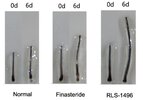
Rubedo Life Sciences announced that it would start a clinical trial in 2026 to test its GPX4 modulator to treat hair loss. https://www.businesswire.com/news/h...ence-Demonstrates-Robust-Hair-Follicle-Growth
The trial will be led by Dr. Pariser, a former President of the American Academy of Dermatology. Modulation of GPX4 is thought to clear aged senescent cells, including from the roots of miniaturising and thinning hair follicles.
RLS-1496 has already demonstrated efficacy in clinical trials for treating dermatological conditions, such as actinic keratoses, atopic dermatitis, psoriasis, and skin aging. https://www.businesswire.com/news/h...ue-Psoriasis-Atopic-Dermatitis-and-Skin-Aging
Check out this 2025 interview with Dr. Quarta. https://lifespan.io/marco-quarta-on-cellular-senescence-in-aging/
Also of interest, RLS-1496 uses Rubedo's proprietary, AI-driven drug discovery platform ALEMBIC. It identifies targets within pathologic senescent cells and then develops ''selective cellular rejuvenation medicines'' for these targets.
Last edited: