
People on propecia with normal estrogen

Bryan

Senior Member
Staff member
Reaction score
43
Todd said:
Bryan said:
Do you really think that the production of estrogen is controlled by a mechanism that involves or includes a feedback loop? Can you cite any medical references in support of that idea?

Sure, Bryan.
In the first image, you can see how the production of estrogen feeds back on the hypothalamus and higher cerebral systems to regulate it self. The same goes for testosterone. {snip all three images}

Thanks for posting those pictures, Todd, but that's not really what I was talking about. I'm familiar with the HPT axis and its feedback loop which controls the synthesis of testosterone via FSH, LH, and (indirectly) estrogen. I've been posting occasionally about that for YEARS on hairloss sites! :)

What I specifically wanted to know is whether or not the synthesis of estrogen (not testosterone) is regulated directly by a feedback loop. That issue isn't even addressed -- much less answered -- in any of those images you posted. I've done a fair amount of reading on this kind of stuff over the years, and I've never seen anything that suggests that the body regulates the production of estrogen in a similar way that it regulates testosterone. Now that you know where I'm coming from, do you have any thoughts on that issue?
 

Bryan

Senior Member
Staff member
Reaction score
43
amsch said:
Bryan said:
amsch said:
However, this does not explaint while many users notice breast enlargement (not always full-blown gyno) while on finasteride.

Maybe it has to do with the sharp reduction of DHT.

So why should drugs like arimidex and tamoxifen help in that case?

I wouldn't expect them to help much in that case. Whether or not they really do, and to what extent (if any) that they do, I'm not really sure. I'd like to see some serious medical research on that. Do you know of any? Something besides just Internet anecdotes?
 

BoilerRoom

Established Member
Reaction score
0
Bryan said:
My own complete guess is that since estrogen (I'm talking estradiol here) is made from testosterone, maybe it rises around 5%-10% or so, same as testosterone.


I believe Merck stated that estradiol rises equally to that of estrogen, which would be about 15%.

I also don't even trust that figure. Testosterone levels are highest in the morning and, when on propecia, your estrogen levels would also be highest in the morning.

I would bet that Merck tested men on propecia in the evening/afternoon to lower this figure even more.
 

Todd

Established Member
Reaction score
8
Bryan said:
Todd said:
Bryan said:
Do you really think that the production of estrogen is controlled by a mechanism that involves or includes a feedback loop? Can you cite any medical references in support of that idea?

Sure, Bryan.
In the first image, you can see how the production of estrogen feeds back on the hypothalamus and higher cerebral systems to regulate it self. The same goes for testosterone. {snip all three images}

Thanks for posting those pictures, Todd, but that's not really what I was talking about. I'm familiar with the HPT axis and its feedback loop which controls the synthesis of testosterone via FSH, LH, and (indirectly) estrogen. I've been posting occasionally about that for YEARS on hairloss sites! :)

What I specifically wanted to know is whether or not the synthesis of estrogen (not testosterone) is regulated directly by a feedback loop. That issue isn't even addressed -- much less answered -- in any of those images you posted. I've done a fair amount of reading on this kind of stuff over the years, and I've never seen anything that suggests that the body regulates the production of estrogen in a similar way that it regulates testosterone. Now that you know where I'm coming from, do you have any thoughts on that issue?

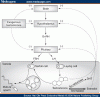
Do I really think production of estrogen in any way involve a feedback loop? yes, as the images clearly explains.
Do I really think it's regulated in the exact same manner as testosterone, and DIRECTLY upon itself? No, as the images clearly explains.

You are quite right to point out that estrogen is indirectly regulated. This picture clarifieses that
 

Attachments

  • ncpem578840.fig1.gif
    ncpem578840.fig1.gif
    61 KB · Views: 241

Bryan

Senior Member
Staff member
Reaction score
43
BoilerRoom said:
I believe Merck stated that estradiol rises equally to that of estrogen, which would be about 15%.

I assume you meant to write "testosterone", rather than "estrogen". In any event, that's a lot more modest than what amsch thinks. He thinks it rises by 100% to 200%! :)
 

Bryan

Senior Member
Staff member
Reaction score
43
Todd said:
Do I really think production of estrogen in any way involve a feedback loop? yes, as the images clearly explains.
Do I really think it's regulated in the exact same manner as testosterone, and DIRECTLY upon itself? No, as the images clearly explains.

I don't really care about the indirect feedback loop for estrogen that involves the synthesis of testosterone. That particular loop has been firmly established for a long time. All I'm interested in at the moment is whether or not there's a specific loop for the synthesis of estrogen itself. There apparently isn't any.
 

amsch

Senior Member
Reaction score
1
Bryan said:
amsch said:
Hm, maybe 100 - 200%?

Why do you suppose finasteride studies have reported no significant effects on estrogen?

BTW, bryan. I'm sure you heard about the Vioxx-thing back then. It was proven thack Merck (MSD) forged the studies about this drug.

So how shall we know that the side effect percentage is real?
 

amsch

Senior Member
Reaction score
1
BoilerRoom said:
Bryan said:
I assume you meant to write "testosterone", rather than "estrogen". In any event, that's a lot more modest than what amsch thinks. He thinks it rises by 100% to 200%! :)


No. Why would I have meant that? I'm sure estradiol is directly related to the amount of estrogen. If estrogen rises by a given percentage then probably so will estradiol.

Testosterone isn't probably directly related to estradiol content because of the variable of DHT.

Bryan, you know i was refering to my case which showed that my estrogen lvl was raised by about 100%, even if i don't have before tests. on all the afters it was about the same, around 40. Why do you deny that?
 

Bryan

Senior Member
Staff member
Reaction score
43
BoilerRoom said:
Bryan said:
I assume you meant to write "testosterone", rather than "estrogen". In any event, that's a lot more modest than what amsch thinks. He thinks it rises by 100% to 200%! :)

No. Why would I have meant that? I'm sure estradiol is directly related to the amount of estrogen. If estrogen rises by a given percentage then probably so will estradiol.

But estradiol IS a form of estrogen, which is why you confused me by what you said earlier: "I believe Merck stated that estradiol rises equally to that of estrogen, which would be about 15%."

It's well-known that taking finasteride can generally raise serum testosterone by about ~10% or so (although there are certain inconsistencies even in that), so I figured you must have mistakenly typed "estrogen", when you meant to type "testosterone". Since estrogen/estradiol is made from testosterone, it makes perfect sense that the synthesis of estrogen/estradiol would generally parallel the production of testosterone. In other words, if testosterone goes up or down by 10%, so would estradiol (probably, anyway).

BoilerRoom said:
Testosterone isn't probably directly related to estradiol content because of the variable of DHT.

PLEASE PLEASE explain more precisely what you mean by that! :)
 

Bryan

Senior Member
Staff member
Reaction score
43
amsch said:
Bryan, you know i was refering to my case which showed that my estrogen lvl was raised by about 100%, even if i don't have before tests. on all the afters it was about the same, around 40. Why do you deny that?

I don't have a problem with the "after" tests, I only have a prolem with the one single "before" test (while on finasteride). I'm dubious about that one.
 

BoilerRoom

Established Member
Reaction score
0
Bryan said:
BoilerRoom said:
Testosterone isn't probably directly related to estradiol content because of the variable of DHT.

PLEASE PLEASE explain more precisely what you mean by that! :)

The rise in testosterone is only approximately equal to that of estrogen, but I bet the increase in estradiol is equal to that of the estrogen.
..and, yes, I know estradiol is a form of estrogen. But this really isn't important to the original point of this thread.


I really don't know why the increase in testosterone would equal that of estrogen when there is about 30% of original DHT remaining. Should the rise in estrogen be only 70% of testosterone?
 

Bryan

Senior Member
Staff member
Reaction score
43
BoilerRoom said:
The rise in testosterone is only approximately equal to that of estrogen, but I bet the increase in estradiol is equal to that of the estrogen.

So what do you mean by "estrogen"? Please be specific.

BoilerRoom said:
I really don't know why the increase in testosterone would equal that of estrogen when there is about 30% of original DHT remaining. Should the rise in estrogen be only 70% of testosterone?

I have absolutely no idea what you're talking about. Please explain, if you can.
 

BoilerRoom

Established Member
Reaction score
0
Can someone help explain the feedback loop step by step in regard to propecia usage?

Are estradiol's (an increase) and DHT's (a decrease) effects on the brain and hypothalamus, respectively, negated? Does this result in pre-propecia levels of GnRH?
 

BoilerRoom

Established Member
Reaction score
0
Bryan said:
I have absolutely no idea what you're talking about. Please explain, if you can.


I was simply questioning why with propecia usage do increases in testosterone parallel that of estrogen. This makes no sense considering that propecia only eliminates 70% of DHT. The remaining 30% of DHT should block some of that testosterone being aromatized into estrogen. I would expect increases in estrogen to be slightly lower than that of testosterone.

However...

I am skeptical of how people are ready to dismiss a significant increase in estrogen. If in fact your estrogen levels are raised ~15% with propecia, you are compounding this increase with a lack of DHT in androgen sensitive tissue throughout the body, such as breast tissue.

I believe propecia cause gyno (or even mild gyno symptoms) and fat tissue accumulation in much greater frequently than say administering exogenous estrogen to cause a 15% increase would.
 

BoilerRoom

Established Member
Reaction score
0
Bryan said:
I've always had a basic distrust of blood tests.

I like how you say that right after you posted blood tests that show no significant increases in estradiol with propecia usage.
 

Bryan

Senior Member
Staff member
Reaction score
43
BoilerRoom said:
I was simply questioning why with propecia usage do increases in testosterone parallel that of estrogen.

I don't think they closely parallel each other. I think they only roughly parallel each other.

BoilerRoom said:
This makes no sense considering that propecia only eliminates 70% of DHT. The remaining 30% of DHT should block some of that testosterone being aromatized into estrogen.

I'm sure it does do that, at least to some modest extent. But all of these factors put together are so complicated, surely you don't think you can use logic to actually PREDICT what the resulting values of estrogen should be, do you? :)

BoilerRoom said:
I would expect increases in estrogen to be slightly lower than that of testosterone.

I tend to agree with you.
 

Bryan

Senior Member
Staff member
Reaction score
43
BoilerRoom said:
Bryan said:
I've always had a basic distrust of blood tests.

I like how you say that right after you posted blood tests that show no significant increases in estradiol with propecia usage.

It's the lab used by your local doctor in Podunk, Iowa, that I don't fully trust, especially when the results are based on one single test. I have a lot more confidence and trust in the blood tests used by scientists who are doing serious research and development that's going to be published in medical journals, especially when those results are based on multiple blood tests.
 
Top