
- Reaction score
- 8,252
II found this also that is interesting
Arrector Pili Muscle and Androgenetic Alopecia
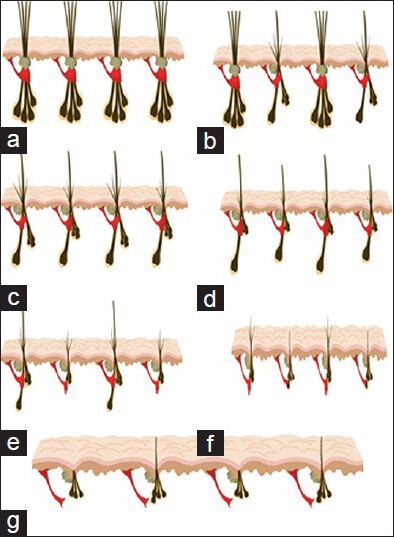
Hair exists as follicular units consisting of 3-5 terminal hairs per follicular unit nourished by a single arborizing arrector pili muscle (APM), which attaches circumferentially around the primary follicle with variable attachment to other follicles (91,97). A study by Yazdabadi et al demonstrated that in MAA and female pattern hair loss, where follicle miniaturization is either irreversible or only partially reversible, there was a consistent loss of attachment of the APM to vellus hair follicles (Figure 6). This was in contrast to potentially reversible alopecia areata, in which the APM maintained contact with the miniaturized secondary vellus follicles (Figure 7). The study suggests that the persisting contact between the APM and follicular unit predicts reversibility of miniaturization (106).
A recent proposition for the pathogenesis and mechanism of androgenetic alopecia suggests that in the early stages of MAA, the arrector pili muscle remains attached to the primary follicle, yet loses attachment to a number of the regressing secondary follicles in some follicular units (81). As further miniaturization and detachment occurs, patients may first notice a change in their hair density and complain of thinning. Once the arrector pili muscle has detached from all secondary follicles and primary follicles have undergone miniaturization and detachment, hair loss is likely irreversible (81). This proposed mechanism establishes the importance of early treatment to halt balding prior to the loss of primary hair follicles.
Arrector Pili Muscle and Androgenetic Alopecia
Hair exists as follicular units consisting of 3-5 terminal hairs per follicular unit nourished by a single arborizing arrector pili muscle (APM), which attaches circumferentially around the primary follicle with variable attachment to other follicles (91,97). A study by Yazdabadi et al demonstrated that in MAA and female pattern hair loss, where follicle miniaturization is either irreversible or only partially reversible, there was a consistent loss of attachment of the APM to vellus hair follicles (Figure 6). This was in contrast to potentially reversible alopecia areata, in which the APM maintained contact with the miniaturized secondary vellus follicles (Figure 7). The study suggests that the persisting contact between the APM and follicular unit predicts reversibility of miniaturization (106).
A recent proposition for the pathogenesis and mechanism of androgenetic alopecia suggests that in the early stages of MAA, the arrector pili muscle remains attached to the primary follicle, yet loses attachment to a number of the regressing secondary follicles in some follicular units (81). As further miniaturization and detachment occurs, patients may first notice a change in their hair density and complain of thinning. Once the arrector pili muscle has detached from all secondary follicles and primary follicles have undergone miniaturization and detachment, hair loss is likely irreversible (81). This proposed mechanism establishes the importance of early treatment to halt balding prior to the loss of primary hair follicles.