You may have read the studies which indicate that the effectiveness and response someone has from minoxidil is determined by the amount of sulfotransferase enzyme activity that person has, which varies among people. The minoxidil sensitivity test which tests for sulfotransferase which was supposed to be released for the US, I don't think it has been legitimately released, I don't see it being sold from google or any major vendor/retailer. The HairMax laser comb has a 5 month money back guarantee, impressive before/after photos, and several clinical studies showing it's effectiveness. I've on finasteride right now, and only used minoxidil once last night but I'm wondering if I should use the laser instead. I wouldn't lose money, and wouldn't have to worry about not having sulfotransferase, and it if it did work it would be cheaper and easier in the long run. These minoxidil sulfotransferase studies also claim that minoxidil only works in about 33% of the population because of the varying sulfotransferase enzyme activity in individuals.

You are using an out of date browser. It may not display this or other websites correctly.
You should upgrade or use an alternative browser.
You should upgrade or use an alternative browser.
Sulfotransferase - Smarter To Use Lasercomb Than Minoxidil?
- Thread starter Oliver510
- Start date

Laser comb is bs.
http://www.hairmax.com/clinical-research-results/
The first published study on that page, shows that increase in hair counts were comparable to finasteride and minoxidil.

- Reaction score
- 11,950
http://www.hairmax.com/clinical-research-results/
The first published study on that page, shows that increase in hair counts were comparable to finasteride and minoxidil.
It took me a while to understand, but a whole lot of published studies are BS.
Manufacturer's studies are just untrustworthy, period.
It took me a while to understand, but a whole lot of published studies are BS.
Manufacturer's studies are just untrustworthy, period.
Have any thoughts on sulfotransferase and/or advice for me?
- Reaction score
- 11,950
Use minoxidil and evaluate after 6 months.
minoxidil is like literally 5 dollars a month to use its the cheapest male pattern baldness treatment there is, and is one of the most time tested/proven ones. Your honestly silly to not be using minoxidil given its a topical/pretty safe,proven to work, and very very cheap. What is the downside other then pain to apply a topical?
Every guy should be minoxidil for any hair loss at all. Its too cheap not to. The comb thing is probably way over priced and probably works worse.
Every guy should be minoxidil for any hair loss at all. Its too cheap not to. The comb thing is probably way over priced and probably works worse.
minoxidil is like literally 5 dollars a month to use its the cheapest male pattern baldness treatment there is, and is one of the most time tested/proven ones. Your honestly silly to not be using minoxidil given its a topical/pretty safe,proven to work, and very very cheap. What is the downside other then pain to apply a topical?
I'm glad you asked, because I was just reading other threads on this forum where users who used minoxidil mentioned how they did not experience any regrowth with it after months of usage, but also after quitting minoxidil they lost hair. Why should one use minoxidil if it may not regrow but then also make you lose the hair you had before you started using it after you quit? I'm taking finasteride to maintain and can live with the amount of hair I have now but how can I risk losing more?
- Reaction score
- 11,950
I'm glad you asked, because I was just reading other threads on this forum where users who used minoxidil mentioned how they did not experience any regrowth with it after months of usage, but also after quitting minoxidil they lost hair. Why should one use minoxidil if it may not regrow but then also make you lose the hair you had before you started using it after you quit? I'm taking finasteride to maintain and can live with the amount of hair I have now but how can I risk losing more?
That makes no sense.
That makes no sense.
Meaning not only did their hair not improve in terms of regrowth, they lost the hair they already had before starting minoxidil in the areas they applied it to. In other words, they went worse than baseline after quitting. Their is a graph that shows that, and it also shows an increase towards baseline eventually but it never shows actually reaching it, and anecdotal reports suggest the same thing.
- Reaction score
- 11,950
Meaning not only did their hair not improve in terms of regrowth, they lost the hair they already had before starting minoxidil in the areas they applied it to. In other words, they went worse than baseline after quitting. Their is a graph that shows that, and it also shows an increase towards baseline eventually but it never shows actually reaching it, and anecdotal reports suggest the same thing.
If it makes no sense, a likely explanation is that they are misinterpreting their situation. Here's what probably happened:
1) They were losing hair, trending down;
2) They go on minoxidil;
3) The trend stabilizes, they're not NW1's again, so they think minoxidil has failed;
4) They go off minoxidil, and go back to where they would have been on the trend.
5) They blame minoxidil.

- Reaction score
- 5,212
Meaning not only did their hair not improve in terms of regrowth, they lost the hair they already had before starting minoxidil in the areas they applied it to. In other words, they went worse than baseline after quitting. Their is a graph that shows that, and it also shows an increase towards baseline eventually but it never shows actually reaching it, and anecdotal reports suggest the same thing.
Why is this so hard to believe? Healthy, already existing terminal hairs can become dependent on minoxidil as well.
If it makes no sense, a likely explanation is that they are misinterpreting their situation. Here's what probably happened:
1) They were losing hair, trending down;
2) They go on minoxidil;
3) The trend stabilizes, they're not NW1's again, so they think minoxidil has failed;
4) They go off minoxidil, and go back to where they would have been on the trend.
5) They blame minoxidil.
In the 6 months or so that someone tries minoxidil and concludes that it doesn't work, they wouldn't necessarily, let alone likely experience the amount of hair loss that occurs after stopping minoxidil compared with what they wouldn't lost 6 months on their original trend. A 30% mean change? I would say unlikely.
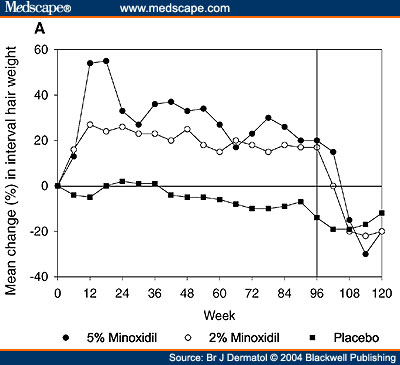
Why is this so hard to believe? Healthy, already existing terminal hairs can become dependent on minoxidil as well.
Yea but would they become permanently dependent? I wouldn't think so.
- Reaction score
- 11,950
In the 6 months or so that someone tries minoxidil and concludes that it doesn't work, they wouldn't necessarily, let alone likely experience the amount of hair loss that occurs after stopping minoxidil compared with what they wouldn't lost 6 months on their original trend. A 30% mean change? I would say unlikely.
Yea but would they become permanently dependent? I wouldn't think so.
After 24 weeks of stopping the drug, the placebo and the minoxidil groups are in the same position, ~20% below baseline. The difference you see is undoubtedly smaller than the measurement error.
20% above baseline appears to be the mean performance after 96 weeks.
After 24 weeks of stopping the drug, the placebo and the minoxidil groups are in the same position, ~20% below baseline. The difference you see is undoubtedly smaller than the measurement error.
20% above baseline appears to be the mean performance after 96 weeks.
Yea but after stopping minoxidil at 96 weeks the decrease from baseline is much greater than decrease in placebo. In between 96 and 108 minoxidil reaches baseline than decreases up until in between 108 and 120, while placebo increases from in the same time frame.
- Reaction score
- 11,950
Yea but after stopping minoxidil at 96 weeks the decrease from baseline is much greater than decrease in placebo. In between 96 and 108 minoxidil reaches baseline than decreases up until in between 108 and 120, while placebo increases from in the same time frame.
No.
Each of the placebo, 2% minoxidil, and 5% minoxidil groups are about ~15% below baseline. The difference between them is statistically insignificant, likely due to either noise or a lack of time.
If it were a "trend", why would the 2% and 5% minoxidil groups be at the same level?
You shouldn't over interpret statistical trends with low sample sizes. They don't have the kind of precision you think they have.
What the graphs show:
- Placebo doesn't work, you get a slow decrease in hair counts;
- 2% minoxidil and 5% minoxidil get you ~25% above baseline, within 3 or 4 months;
- 5% minoxidil is only slightly better than 2% minoxidil;
- When you quit minoxidil, it takes 8 weeks to get back to where you started;
- It takes a further 4 weeks (12 weeks total) to get back to where you would have been without the minoxidil;