Optimal time between day off from daily dose?

treadstone

Established Member
Reaction score
2
It's generally known that skipping a day every once in awhile on finasteride generally is of little significance to your DHT levels. I was wondering, based on the literature what would be the optimal frequency time to take a day off? Every X days? Once every other week?

If only in the interest of saving a bunch of extra pills a year ($$), this would be good information to know.

Bryan, you know the charts inside and out... any thoughts? Or anyone else, for that matter.
 

bubka

Senior Member
Reaction score
16
socks_11.jpg


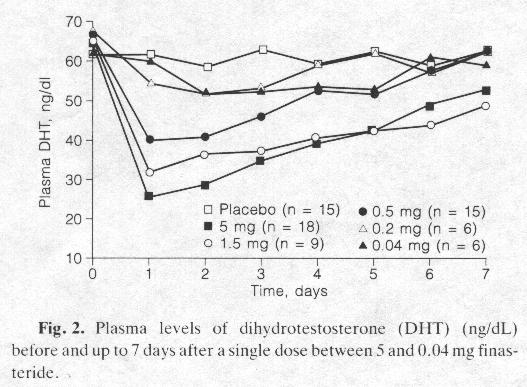
You can see that it takes quite a few days for DHT levels to return; however, I am not sure of your body's DHT reduction that would be effective in combating hair loss. Regardless, I hypothesize that skipping one day a week will matter much.

Dutasteride (0.5mg) is the drug that people have had results only taking 2x a week.
 

Jack23-

Established Member
Reaction score
0
Bubka, a question for you -

I've been on 0.5mg of Finpecia for almost a month now with no sides.

Thinking about upping my dose to 1mg. But after looking at this chart, would you say it would make any real difference?
 

bubka

Senior Member
Reaction score
16
Look how much more DHT is inhibit by a large greater than 0.5mg
socks_11.jpg


Now sure that dosage could possibly cause side effects where the lower dosage will not, but the chance of getting side in the first place are already low.

Maybe bump it up to 1mg and see how it goes, you know you can always go back to 0.5mg
 

Jack23-

Established Member
Reaction score
0
Thanks for that Bubka.

The 1.5 and 0.5 mg isnt a major leap, but i'm guessing it would obviously increase my chances of stopping hairloss. The reason i started with 0.5 was to get myself on the drug, but now people are saying its pointless. Oh well. :whistle:
 

medmax84

Established Member
Reaction score
1
bubka said:
Look how much more DHT is inhibit by a large greater than 0.5mg
socks_11.jpg


Now sure that dosage could possibly cause side effects where the lower dosage will not, but the chance of getting side in the first place are already low.

Maybe bump it up to 1mg and see how it goes, you know you can always go back to 0.5mg

What this single-dose graph FAILS to demonstrate is that there will be a cumulative effect. Even though finasteride is cleared from the serum in 24-48 hours, the 5alpha reductase inhibition IS cumulative because of the need for regeneration of the 5AR enzyme which takes longer than that time. So regardless of dose past a certain point, the inhibitor (finasteride) will reach its Vmax in the binding of the 5AR molecule and maintains at that point as you continue daily dosage. My suspicion is that if you take finasteride every other day, you also reach this point but it takes significantly longer. It is limited because the Type 2 5AR enzyme is only a fraction of the total serum 5AR enzyme produced.

My speculative suspicion is that there is a flat dose curve past a certain point, because finasteride's binding to the 5AR Type II enzyme reaches near saturation a relatively low dose. It preferentially binds Type II 5AR, but at higher concentrations it probably binds Type I 5AR but only with a slight affinity. That is why between 0 and .25 you see a SHARP increase in the percentage of inhibition but between .25 and 5 mg you see a significantly smaller increase.

A lot of this is speculation, please don't adjust your dosage based on my thoughts.
 

Bryan

Senior Member
Staff member
Reaction score
43
medmax84 said:
It is limited because the Type 2 5AR enzyme is only a fraction of the total serum 5AR enzyme produced.

The 5a-reductase enzymes don't appear in the blood. They are exclusively cellular enzymes. They are tightly-bound to certain membranes inside the cells. They don't appear anywhere else.

medmax84 said:
My speculative suspicion is that there is a flat dose curve past a certain point, because finasteride's binding to the 5AR Type II enzyme reaches near saturation a relatively low dose. It preferentially binds Type II 5AR, but at higher concentrations it probably binds Type I 5AR but only with a slight affinity.

Here's what Gisleskog et al say about the potency of finasteride against the type 1 enzyme near the end of one of their studies on finasteride/dutasteride:

"No effect of finasteride on 5a-reductase type 1 was included in the current model. However, finasteride was shown to interact with 5a-reductase type 1 in vitro with with a second-order rate about 2.2% of the rate constant for the GI198745-5a-reductase type 1 interaction. If the same relation....is true in vivo, a steady-state finasteride concentration of about 1200 ng/mL would be needed to suppress 5a-reductase type 1 by 50%. Assuming linear pharmacokinetics, daily doses of about 270 mg finasteride would be required to achieve average concentrations of this magnitude..."
 

medmax84

Established Member
Reaction score
1
Bryan said:
medmax84 said:
It is limited because the Type 2 5AR enzyme is only a fraction of the total serum 5AR enzyme produced.

The 5a-reductase enzymes don't appear in the blood. They are exclusively cellular enzymes. They are tightly-bound to certain membranes inside the cells. They don't appear anywhere else.

medmax84 said:
My speculative suspicion is that there is a flat dose curve past a certain point, because finasteride's binding to the 5AR Type II enzyme reaches near saturation a relatively low dose. It preferentially binds Type II 5AR, but at higher concentrations it probably binds Type I 5AR but only with a slight affinity.

Here's what Gisleskog et al say about the potency of finasteride against the type 1 enzyme near the end of one of their studies on finasteride/dutasteride:

"No effect of finasteride on 5a-reductase type 1 was included in the current model. However, finasteride was shown to interact with 5a-reductase type 1 in vitro with with a second-order rate about 2.2% of the rate constant for the GI198745-5a-reductase type 1 interaction. If the same relation....is true in vivo, a steady-state finasteride concentration of about 1200 ng/mL would be needed to suppress 5a-reductase type 1 by 50%. Assuming linear pharmacokinetics, daily doses of about 270 mg finasteride would be required to achieve average concentrations of this magnitude..."

:) you learn some everyday. I stand corrected. It was conjecture based on a false assumption. Thanks.

I was discussing how you reach a therapeutic steady-state, ie a steady level of DHT inhibition. There has to be a limiting factor based upon the fact that DHT is inhibited in a cumulative fashion up to a point where the inhibition plateaus and DHT approaches probably 30-40% of the normal DHT serum concentration. Would you say this is where the 5AR-finasteride saturation curve is approaching Vmax in an asymptotic fashion and the result we're seeing is a maximum decrease in DHT for the drug?
 

Bryan

Senior Member
Staff member
Reaction score
43
treadstone said:
It's generally known that skipping a day every once in awhile on finasteride generally is of little significance to your DHT levels. I was wondering, based on the literature what would be the optimal frequency time to take a day off? Every X days? Once every other week?

If only in the interest of saving a bunch of extra pills a year ($$), this would be good information to know.

Bryan, you know the charts inside and out... any thoughts?

Honestly, I've never seen or heard of any studies that addressed the subject of intermittent dosing of finasteride, so anything that seems even half-way reasonable must be ok. If you want to skip a day once a week, I'd say go for it! :)
 

Bryan

Senior Member
Staff member
Reaction score
43
medmax84 said:
I was discussing how you reach a therapeutic steady-state, ie a steady level of DHT inhibition. There has to be a limiting factor based upon the fact that DHT is inhibited in a cumulative fashion up to a point where the inhibition plateaus and DHT approaches probably 30-40% of the normal DHT serum concentration. Would you say this is where the 5AR-finasteride saturation curve is approaching Vmax in an asymptotic fashion and the result we're seeing is a maximum decrease in DHT for the drug?

Yes! :) (I'm not trying to be a smartass here, you stated all that clearly and succinctly!)

The only thing I want to add here is that you CAN force the inhibition of the type 2 enzyme even higher (well, the type 1 enzyme, too, for that matter) with increasingly higher and higher doses of finasteride. But I agree with the gist of what you're saying.
 

Bryan

Senior Member
Staff member
Reaction score
43
Some of you may not have seen this set of graphs from an early finasteride study which I posted over on HLH. It shows that even when you take very low daily doses (as low as 0.04 mg/day, in this example), serum DHT levels decline to almost as low as what they do when taking a full Propecia dose of 1.0 mg/day. It takes a while (a few days) for that to happen, whereas the 1 mg dose gets there quickly. Graph A is the one you want to study carefully:

microdose10se3ti5.jpg
 
Top