Armando Jose said:
Dear Doctor;
is this clasiffication universal to both sexes?
If yes, I would like very much read the whole study.
Armando
I don't really have time to reorganize the tables, so I apologize in advance.
Pattern hair loss (PHL) is the most common type of baldness that occurs after puberty in both sexes. Patients typically present with the progressive thinning and shortening of hair in affected areas. Until recently, various classification methods have been proposed for describing PHL. In 1950, Beek[1] published the results of classification, using two evolutive aspects for 1000 white males (frontal and frontovertical baldness). In the next year, the first systematic classification of PHL was established by Hamilton.[2] Hamilton subclassified the patterns of baldness based on frontoparietal and frontal recession and vertex thinning and then evaluated a large group of men and women for the presence of specific patterns of hair loss from the prenatal period through the tenth decade of life. In 1975, Norwood[3] refined Hamilton's classification by emphasizing temporofrontal or vertex only subcategories of hair loss into seven types with a type A variant and reported the incidence of male pattern baldness at various ages in 1000 white, adult male subjects. An additional pattern to the Hamilton–Norwood classification system (II vertex) was introduced in the clinical trial of finasteride in male PHL (MPHL).[4] In 1992, Savin introduced a classification of MPHL based entirely on a pictorial depiction of hair density as derived from midline scalp part width. [5] , [6] , [7] Olsen first proposed assigning separate designations (temporal, frontal, mid, and vertex) to the areas of the scalp that bald at different rates in different individuals with MPHL. [8] , [9] Olsen also proposed an individualized classification system that assigned a density scale to each of these designated scalp areas in any given patient, which was further refined in a later publication. [9] , [10] Subjects thus classified would have a TFMV classification (e.g., T3F2M0V3).[9]
In 1977, Ludwig[11] presented quite a different picture of hair loss in women from that described by Hamilton. He emphasized preservation of the frontal fringe despite progressive centrifugal loss over the top of the scalp and arbitrarily designated three gradations of hair loss. Recently, Olsen proposed that frontal accentuation (or the “Christmas tree†pattern) be considered another pattern of hair loss in women, which helps to distinguish PHL from other potential hair-loss mimicries in women. [6] , [9] , [12] Olsen also devised both a hybrid classification system for female pattern hair loss (FPHL) that combined the Ludwig patterns with the Savin hair density scale, and a classification based on 3 grades of overall density in either a Ludwig or a frontal accentuation pattern. [6] , [8]
Bouhanna [13] , [14] designed a dynamic, multi-factorial classification of certain parameters, such as fixed distances of the face, scalp mobility and thickness, and covering power of hair, that can be quantified and computerized for a more precise surgical approach. Recently, in 2000, Koo et al[15] classified the type of male pattern baldness into 6 types according to the English alphabetical letter shape of the bald area. They then studied the prevalence of MPHL in 1731 Korean men based on their method and according to age and types of baldness. Presently, Norwood's classification for MPHL and Ludwig's classification for FPHL are the most commonly used classification methods for assessing PHL worldwide.
Although the several aforementioned classification methods of PHL have been suggested, these existing classifications have some limitations. The Norwood–Hamilton classification is too detailed and is less stepwise in its description, making it difficult to memorize for common use. Norwood–Hamilton classification also does not list some peculiar types of baldness, such as FPHL. Additionally, many women with MPHL cannot be classified using the Ludwig classification system. [6] , [9] In addition, for most of these classification systems, the clinicians must use distinct methodologies for each gender in order to correctly classify the pattern. Thus, a more widely accepted, accurate, and stepwise method of classification for PHL would be of great benefit.
We therefore devised a new classification system, named BASP classification, which is comprehensive and systematic regardless of race and gender. This classification system was applied to classify patterns of PHL in Korean patients. Herein we present the BASP classification method and the data concerning the incidence of PHL, pertaining to morphological classification and age.
Materials and methods
The BASP classification
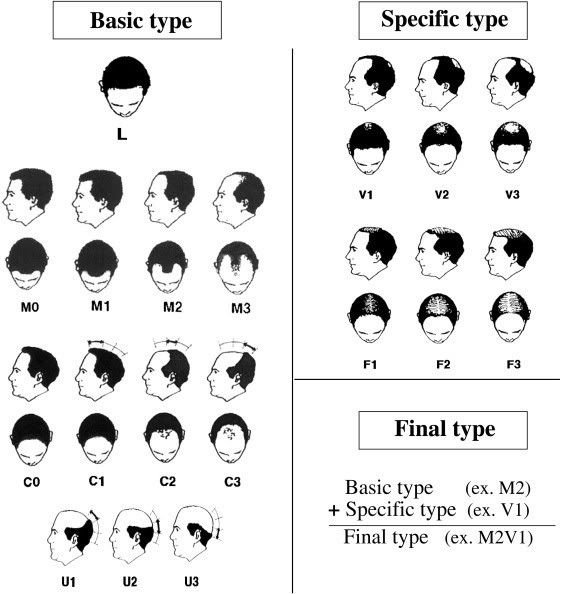
This new classification of PHL was designed based on the pattern of hair loss, including the shape of the anterior hairline and the density of hair on the frontal and vertex areas. There are four basic types and two specific types. The basic types represent the shape of the anterior hairline, and the specific types represent the density of hair on specific areas, which are frontal and vertex. The final type is decided by the combination of the basic and specific type. One of the basic types must be selected, and the specific type may be selected if it exists. Each of the various types is subdivided into 3 or 4 grades (subtypes), according to its severity. Hence, we called this method BASP classification, composed of the initial two letters of BAsic and SPecific. Scattered sparse hairs and islands of hair may persist in the area of denudation. If the alopecic pattern of a subject cannot be classified by our new method, additional descriptions may be added.
Basic type
The shape of the anterior hairline is divided into 4 basic types: L, M, C, and U (Fig 1). The basic types are classified by the English alphabetical letter shape of the anterior hairline, except L type, which means “linear.†Types M, C, and U are subdivided into 3 or 4 grades, based on severity. The reference points of classification are set to the original anterior hairline, the top of vertex (the highest point on the posterior crown), and the occipital protuberance. We posited that the patient's subjective recognition of hair loss is more significant than the doctor's identical indicator, and so we introduced the concept of the original anterior hairline in our basic type classification. The original anterior hairline is defined as the anterior hairline at that time while baldness dose not yet occur. Therefore, the clinical history of hair loss is necessary to precisely differentiate among grades.
Fig 1 The BASP classification system. Four basic types (L, M, C, and U) and two specific types (V and F) are used in the BS classification. The basic types represent the shape of the anterior hairline, and the specific types represent the density of hair on specific areas (frontal and vertex). The final type is decided by a combination of the basic and specific type. It was named BASP for the BA in basic type and the SP in specific type.
Type L
No recession is observed along the anterior border in the frontotemporal region. It resembles a linear line and usually means that no hair loss has occurred.
Type M
Recession in the frontotemporal hairline is more prominent than the mid-anterior hairline. This type tends to be symmetrical. The hairline resembles the letter M. Type M is further divided into 4 subtypes depending on the severity of baldness.
Type M0
The original hairline is preserved and represents type M. No hair loss has occurred on clinical history. The subject cannot perceive any changes in the anterior hairline.
Type M1
Frontotemporal recession extends posteriorly but not beyond the anterior third of a virtual line connecting the original hairline and the top of the vertex.
Type M2
Frontotemporal recession extends further posteriorly but not beyond the middle third of a virtual line connecting the original hairline and the top of the vertex.
Type M3
Frontotemporal recession extends beyond the middle third section into the posterior third of the area of a virtual line connecting the original hairline and the top of the vertex.
Type C
Recession in the mid-anterior hairline is more prominent than the frontotemporal hairline. The entire anterior hairline regresses posteriorly in the shape of half-circle, resembling the letter C. Type C is further divided into 4 subtypes depending on the severity of baldness.
Type C0
The original anterior hairline is preserved and represents type C. No hair loss has occurred on clinical history.
Type C1
The mid-anterior hairline recedes so that it lies within the anterior third of the virtual line connecting the original hairline and the top of the vertex.
Type C2
The mid-anterior hairline recedes further so that it lies within the middle third of the virtual line connecting the original hairline and the top of the vertex.
Type C3
The mid-anterior hairline recedes further into the posterior third of the virtual line connecting the original hairline and the top of the vertex.
Type U
The anterior hairline recedes posteriorly beyond the vertex forming a horseshoe shape, resembling the letter U. Type U is the most severe pattern of androgenetic alopecia (Androgenetic Alopecia). Type U is further divided into three subtypes depending on the severity of baldness. There is no zero grade (UO).
Type U1
The entire anterior border of the hairline lies within the superior third of the virtual line connecting the vertex and the posterior occipital protuberance.
Type U2
The entire anterior border of the hairline lies within the middle third of the virtual line connecting the vertex and the posterior occipital protuberance.
Type U3
The entire anterior border of the hairline lies within the inferior third of the virtual line connecting the vertex and the posterior occipital protuberance.
Specific type
The basic types cannot represent the thinning of hair on the scalp, so additional types representing the degree of thinning need to be introduced. In contrast to the basic types, the specific types may be selectively included when necessary. According to patterns observed at specific areas, there are two specific types: F and V. Each specific type is also subdivided into 3 subtypes, according to severity. When all the characteristics of both types F and V are observed, both specific types should be selected.
Type F
This type only represents a general decrease in the density of hair over the entire top of the scalp, regardless of the anterior hairline. It is usually more marked over the frontal area of the scalp, as observed in FPHL. This type is similar to Ludwig's classification method but only with regard to thinning hair, and is unrelated to the shape of the entire hairline.
Type F1
Thinning of the hair on the crown is perceptible (mild change).
Type F2
Thinning of the hair on the crown is pronounced (moderate change).
Type F3
The hair on the crown is very spare or absent (severe change).
Type V
The hair around the vertex is notably sparser. Hair loss is seen more distinctly in the vertex than in the frontal area. When frontoparietal and vertex regions of alopecia have become confluent, type F2∼3 should not be confused with type V. In this case, the differential point is whether the definite hair loss is primarily on the vertex or not.
Type V1
Thinning of the hair around the vertex area is perceptible (mild change).
Type V2
Thinning of the hair around the vertex area is pronounced (moderate change).
Type V3
The hair around the vertex area is very spare or absent (severe change).
Some examples that were classified using the BASP method are shown in Fig 2.
Fig 2 Examples of BASP classification of pattern hair loss. A, A 32-year-old male, LF2 type. B, A 49-year-old male, M2F2 type. C, A 59-year-old male, M1V3F2 type. D, A 27-year-old male, C1V2F1 type. E, A 48-year-old male, U2 type. F, A 45-year-old female, LF2 type. G, A 58-year-old female, C1F3 type. H, A 32-year-old female, M1F1 type.
Patients
Two thousand two hundred and thirteen Korean subjects were studied (1768 males and 445 females) and classified according to the previously described classification. Subjects were mostly outpatients and some inpatients that complained about hair loss and were diagnosed with PHL at one of 13 university dermatologic centers nationwide in South Korea between November 2004 and June 2005, as part of a multi-center study of the Korean Hair Research Society. This study was approved by the ethics committee of Korean Hair Research Society.
We excluded persons who might have had any hair diseases and had been treated for hair growth within 6 months before enrollment or who had any condition influencing hair growth, such as childbirth, high fever, severe emotional stress, metabolic disease, or anticancer treatment.
In each subject to whom the above exclusion criteria did not apply and who consented to the enrollment, a dermatologist at each center carefully examined and classified the type of hair loss according to our new standards. Additionally, a questionnaire regarding perceptible duration of hair loss, family history of baldness, previous treatment history for PHL, chronic disorders, and drug history was also completed by each subject.
Digital photographs were then taken in sequence with 6 standardized views. These views included: (1) frontal without tilt; (2) 45° tilt and (3) nearly 90° tilt to the front side of the head; (4) anterior view wearing a thin hair band to observe the anterior hairline; and (5 and 6) bilateral 90° side views. In addition to these 6 views, a posterior view of the scalp was taken if the subject was classified as type U. A representative example of the photographs taken is shown in Fig 3.
Fig 3 Six standard views of the clinical photograph. Frontal view without tilt (A), a 45° tilt to the front side of the head (B), a nearly 90° tilt (C), an anterior view (D), and bilateral 90° side views (E and F) to observe the anterior hairline of a patient wearing a thin hair band. The hair loss pattern of this patient is classified as M2F1 type.
Accuracy and ease of use
To test the accuracy of this method of classification, verification tests were performed. Three dermatologists at the department of dermatology at the Yonsei University Wonju College of Medicine, who were well trained to use the new method, classified the baldness patterns of 100 subjects by inspecting the clinical digital photographs of the scalp. The classification accuracy was then evaluated by comparison of the three results.
In order to prove the easy-to-use nature of the new system, the photographs of scalps, which were accorded more than two of three results among the same 100 subjects mentioned above, were assessed by two independent general physicians at Wonju Christian Hospital. These physicians were trained to use our method for only 15 minutes immediately before the test. The classification results of the two general physicians were then compared with the results obtained identically by more than two of the three dermatologists mentioned above.
Results
Age and sex distribution of pattern hair loss
The male subjects totaled 1768 individuals, a number four times as great as the 445 female subjects. The majority of patients were in their third and fourth decade of life in both sexes, encompassing 1150 of male (65.1%) and 252 of female (56.68%) subjects. The number of subjects decreased steadily over the fourth and fifth decades of life.
Incidence of basic type by age group
In men, regardless of age, 1434 men of the 1768 subjects were classified as type M, accounting for 81.1% of cases and being the most common basic type. Among the subtypes and according to the severity of baldness, the majority in subjects below 50 years of age were classified as type M1, whereas most subjects over the age of 50 were classified as type M2 (Table I). Type L (9.3%) tended to decrease with age, but types C (5.8%) and U (3.8%) tended to increase.
Table I -- Distribution of basic type in males by age group
No. (%) by age (y)
Type ≤19 20-29 30-39 40-49 50-59 60-69 ≥70 Total
L L 10 (20.4) 92 (12.0) 30 (7.8) 11 (5.8) 8 (4.7) 9 (7.3) 4 (4.9) 164
M M0 12 (24.5) 100 (13.1) 22 (5.7) 6 (3.1) 2 (1.2) 1 (0.8) 2 (2.4) 145
M1 19 (38.8) 351 (45.9) 155 (40.3) 58 (30.4) 50 (29.1) 27 (21.8) 23 (28.0) 683
M2 4 (8.2) 170 (22.2) 120 (31.2) 54 (28.3) 55 (32.0) 44 (35.5) 28 (34.1) 475
M3 2 (4.1) 28 (3.7) 28 (7.3) 23 (12.0) 24 (14.0) 17 (13.7) 9 (11.0) 131
C C0 — 10 (1.3) 1 (0.3) 1 (0.5) 0 (0.0) 1 (0.8) 1 (1.2) 14
C1 1 (2.0) 3 (0.4) 11 (2.9) 2 (1.0) 3 (1.7) 3 (2.4) — 23
C2 — 7 (0.9) 6 (1.6) 4 (2.1) 3 (1.7) 3 (2.4) — 23
C3 — 1 (0.1) 6 (1.6) 18 (9.4) 6 (3.9) 8 (33.3) 4 (4.9) 43
C 1 (2.0) 21 (2.7) 24 (6.2) 25 (13.1) 12 (7.0) 15 (12.1) 5 (6.1) 103
U U1 1 (2.0) — 1 (0.3) 6 (3.1) 7 (4.1) 3 (2.4) 7 (8.5) 25
U2 — 2 (0.3) 4 (1.0) 6 (3.1) 8 (4.7) 4 (3.2) 1 (1.2) 25
U3 — 1 (0.1) 1 (0.3) 2 (1.0) 6 (3.9) 4 (3.2) 3 (3.7) 17
U 1 (2.0) 3 (0.4) 6 (1.6) 14 (7.3) 21 (12.2) 11 (8.9) 11 (13.4) 67
Total (%) 49 (100) 765 (100) 385 (100) 191 (100) 172 (100) 124 (100) 82 (100) 1768
Types are divided into grades as indicated in the text.
C, Hair loss pattern shaped like the letter C; L, linear; M, hair loss pattern shaped like the letter M; U, hair loss pattern shaped like the letter U.
In women, type L showed the highest frequency in the all age groups, accounting for 210 (47.2%) of 445 female subjects. Regardless of age, types M, C, and U followed in order, with 121 women (27.2%), 111 women (25.0%), and 3 women (0.6%) of the 445 subjects, respectively. Type C0 was the second most common subtype in female subjects between the second and fourth decade of life, and its incidence decreased with age (Table II).
Table II -- Distribution of basic type in females by age group
No. (%) by age (y)
Type ≤19 20-29 30-39 40-49 50-59 60-69 ≥70 Total
L L 8 (38.1) 69 (46.3) 54 (50.9) 30 (46.2) 24 (53.3) 19 (46.3) 6 (54.5) 210
M M0 2 (9.5) 16 (11.0) 10 (9.4) 12 (18.5) 5 (11.1) 9 (22.0) 1 (9.1) 55
M1 3 (14.3) 13 (8.9) 6 (5.7) 13 (20.0) 7 (15.6) 5 (12.2) 3 (27.3) 50
M2 — 1 (0.7) 3 (2.8) 5 (7.7) — 2 (4.9) 1 (9.1) 12
M3 2 (9.5) 2 (1.4) — — — — — 4
C C0 5 (23.8) 35 (24.0) 21 (19.8) 9 (13.8) 4 (8.9) 3 (7.3) — 77
C1 1 (4.8) 8 (5.5) 11 (10.4) 4 (6.2) 2 (4.4) 3 (7.3) — 29
C2 — — — 1 (1.5) 3 (6.7) — — 4
C3 — — — 1 (1.5) — — — 1
U U1 — — 1 (0.9) — — — — 1
U2 — — — — — — — 0
U3 — 2 (1.4) — — — — — 2
Total (%) 21 (100) 146 (100) 106 (100) 65 (100) 45 (100) 41 (100) 11 (100) 445
Types are divided into grades as indicated in the text.
C, Hair loss pattern shaped like the letter C; L, linear; M, hair loss pattern shaped like the letter M; U, hair loss pattern shaped like the letter U.
Incidence of specific type by age group
In men, type F was observed in 42.4% (749/1768) of male subjects, and type V was observed in 19.8% (350/1768). The grade of both types seemed to increase slightly with age (Fig 4, A and B). In women, type F was observed in 70.6% (314/445) of female subjects with Androgenetic Alopecia (Fig 5). The incidence of type V (6.3%) is not shown.
Fig 4 Distribution of degrees of the specific types in male by age group. A, Type V; type V was observed in approximately 20% of male subjects. Increasing with age, type V1 tended to decrease, but the proportion of types V2 and V3 tended to increase. B, Type F; type F was steadily observed in approximately 40% of male subjects. The proportion of type F1 tended to decrease with increasing age, but the proportion of types F2 and F3 tended to increase.
Fig 5 Distribution of degrees of type F in female by age group. The proportion of type F increased with age, especially types F1 and F2, between the second and the sixth decade of life.
Accuracy and ease of use tests
A comparison of the results of the classification performed by three experienced dermatologists is shown in the Table III. The accuracy rate of our classification was defined as the sum of the accordance rate of more than two of three results. The accuracy rate was 96% in basic type classifications, 94% in specific type classifications, and 83% in final type classifications. The accordance rates between the classification result, which was accorded more than two of three expert dermatologist's classifications and two amateur general physicians' classifications, were approximately 80% in all basic, specific, and final types.
Table III -- The results of accuracy and ease of use tests
Basic type Specific type Final type
Factor No. % No. % No. %
Accuracy[∗]
Three all 60/100 94.0% 61/100 96.0% 41/100 83.0%
Two 34/100 35/100 42/100
None 6/100 6.0% 4/100 4.0% 17/100 17.0%
Ease of use[‡]
GP1 79/94 84.0% 76/96 79.2% 59/83 71.1%
GP2 79/94 84.0% 84/96 87.5% 64/83 77.1%
GP, General physician; three all, three results accorded; two, two of three results accorded; none, none of three accorded.
∗ Three dermatologists classified the baldness patterns of 100 subjects by inspecting the clinical digital photographs of the scalp. The classification accuracy was then evaluated by comparison of the three results. The accuracy rate was defined as the sum of the accordance rate of more than two of three results.
‡ The classification results of the two general physicians were then compared with the classification result obtained identically by more than two of the three dermatologists mentioned above.
Discussion
The term Androgenetic Alopecia was coined by Orentreich[16] in 1960, but the same condition in men has been termed “male pattern alopecia,†“common baldness,†“male pattern baldness,†and “male pattern hair loss.†[8] , [17] , [18] Because androgen dependence and hereditary factors are less obvious in affected women than in affected men, the term PHL, which has a more broad concept, is more preferable for women than the term Androgenetic Alopecia. [8] , [9] Therefore, we titled this article using the term PHL, which can be reasonably applied to both sexes.
There are also racial differences in the prevalence and patterns of PHL. [2] , [19] , [20] , [21] In a previous study, a female pattern was observed in 11.1% of Korean males with Androgenetic Alopecia, which is higher than that found in white males.[20] In the current study, a female pattern (type F) accounted for approximately 37% in men, which was more frequent than expected. The prevalence of male pattern baldness accounted for 14.1% in Korean males and 38.5% in Thai males; in white males, it accounted for 46.0%. [3] , [20] , [21] In addition, Japanese men develop Androgenetic Alopecia approximately one decade later than whites, and the prevalence is 1.4-fold lower in each decade of life.[22] Therefore, Asian men with PHL are disposed to have different aspects from those of whites.
PHL in females occurs much more frequently than is generally believed. Price[23] noted that the incidence is the same as in males. Norwood[24] also stated that female Androgenetic Alopecia affects up to 30% of older women. In addition, some females may develop balding in various patterns similar to those of males.[12] PHL clearly was a stressful experience for both sexes, but it was substantially more distressing for women, so these women may need more thoughtful evaluation and management.[25] Accordingly, an additional detailed classification system for women must be developed as a necessity. If a unified classification method for both sexes is developed, it would be most beneficial.
As the results of this research show, the majority of individuals that visited the dermatologic clinic for hair loss were young adults in the third and fourth decade of life and not older. For such patients, a more stepwise classification is required for the proper identification of both a concretely defined early stage and the steps that further describe the process of balding.
In the BASP classification system, the PHL was categorized into basic and specific types. During the balding process, the recession of the anterior hairline, represented with the basic type classification, relatively corresponds with the thinning of hair on the crown and vertex. However, because the degree of recession might be out of accordance with the density of hair in many individuals, the separation of both characteristics is important for proper classification. Furthermore, the combination of two features of PHL is better suited to more thorough description of the baldness phenotypes. This fundamental idea that the viewer can separately match pattern or area with density is similar to the regional scalp hair density method by Olsen[9] using the area of the scalp assigned a letter (T, F, M, and V) and the density of hair in that region of the scalp. But the BASP classification system is different from Olsen's system in that our method focuses on the shape of anterior hairline (basic type), and is a simpler method with a density scale of 0 to 3. We also adopted basic types and specific type V as new guidelines by modifying Hamilton's,[2] Norwood's,[3] and Koo et al's[15] suggested classifications, and specific type F from Ludwig's[11] proposal. The correlation between the representative classifications and our new classification of pattern baldness is shown in Table IV.
Table IV -- Correlation between the representative classifications and BASP classification of pattern hair loss
Male classification BASP classification
Norwood Basic Specific Final
I L, M0∼1, C0∼1 — L, M0∼1, C0∼1
II M1∼2 — M1∼2
IIa C1∼2 — C1∼2
III M2∼3 — M2∼3
III vertex M2∼3 V1 M2∼3 V1
IIIa C2 — C2
IV M2∼3 V2∼3 M2∼3 V2∼3
IVa C2∼3 — C2∼3
V M3, C3 V3 M3V3, C3V3
Va C3 — C3
VI C3, U1 V3 C3V3, U1
VII U2∼3 — U2∼3
Female classification
Ludwig
Grade I L, M0, C0 F1 LF1, M0F1, C0F1
Grade II L, M0, C0 F2 LF2, M0F2, C0F2
Grade III L, M0, C0 F3 LF3, M0F3, C0F3
According to the severity of the phenotype, we also subclassified both the basic and specific types into subtypes in order to generate a more stepwise and systematic classification method. We can describe patterns of hair loss in detail using the new method, and, thus estimate both the further extent of hair loss and the therapeutic response to a certain therapy.
The accuracy of any method of classification based on inspection can be criticized for any procedure based on subjective judgment. In order to check the accuracy of the BASP classification, we carried out a verifying test which was different from Hamiliton's test method. Although the accuracy rate of the BASP method was lower than that obtained by Hamilton, it should be noted that the BASP classification accuracy rate was more than 80% and, when analyzed separately by the basic and by the specific type, reached 94% in basic type and 96% in specific type. If the examiner classified the real scalp of a subject, more accurate results may be expected.
Another test to prove the easy-to-use format of the BASP classification system was performed. In spite of a study period of only 15 minutes, the accordance rates accounted for 77.1% and 71.1% in the final type. This result shows that the BASP classification is easy to learn and practice. Because the BASP classification is easy to memorize, owing to its stepwise and systematical characteristics, there is no difficulty in applying the system clinically. Because the new classification can also be applied to both sexes, it is more universal than previously used methods.
Although the BASP classification may seem to be complex as compared with other classification methods, we think that the BASP classification is not complicated or difficult and has many advantages for describing PHL. In an advanced stage of baldness, confusion between types F and type V may occur. But because scalps with advanced baldness tend to appear similar and all two types exist in fact, such confusion is understandably possible, and careful observation is required. The subjects of this study were mostly outpatients and some inpatients who complained about hair loss. Therefore, our data does not indicate the prevalence and types of PHL in the general population of Korea. However, the results of this study do represent the tendency of people with various types of hair loss to visit the dermatologic clinic.
In conclusion, we expect that the BASP classification may prove particularly useful in communicating the exact amount and distribution of hair loss in those with PHL. Although there are, of course, some shortcomings in our new method, it is easily available, stepwise, and comprehensive regardless of race or sex. Future studies, such as of the incidence of PHL in the general population and of the long-term progression, can be performed using the new system.