High Dht Levels Or Overly Sensitive Receptors?

thiswebsitesucks

New Member
My Regimen
Reaction score
0
What is the consensus on what causes men to lose their hair prematurely?

From what I understand DHT production increases in men as they age, hence why most men start losing head hair before the age of 30. This would mesh with the premise of young men prematurely losing their hair due to them having abnormally high DHT levels at a young age - their levels at 20 are as high as an ordinary non-premature balder whose levels creep up until reaching a critical mass at around 30.

Going against this theory to some capacity, is the notion that men who bald prematurely have overly sensitive receptors. What I can say to this, is that as a person who has decided to let nature run it's course I have gone from being someone with below average body hair as a teen, to someone who is slowly becoming the proverbial hairy mammoth. From what I understand the receptors that are attached to your head are also attached to your body hair and are somehow inversely effected by DHT, hence why guys who lose hair at a young age are often excessively hairy.

There are many accounts on forums of people with excess body hair taking Propecia and losing large amounts of body hair which further corroborates the theory that excessive DHT/ overly sensitive receptors have an inversely related relationship with head hair/ body hair.

Do DHT levels increase with age, or do the follicles become more sensitive over time - like a battery slowly losing it's charge? Are sensitive receptors wide spread throughout the whole body or are they isolated to just a few areas (unlikely to me due to my experience with guys going bald in their early 20s also being very hairy). If that is the case then how can some people be bald, and yet not have much body hair?

What are your thoughts? Could it perhaps be a mixture of both? Has anyone ever met anyone with excessive body hair (upper arms/ shoulders/ back) who wasn't showing signs of hair loss?
 

Bigbone

Established Member
Reaction score
142
I don't know if DHT production increases with age, where did you read that?

It's probably a mixture of both. Firs of all, most people who take finasteride don't notice any difference in body hair and some experince a speed up in body hair growth. There is also people with high DHT but almost zero body hair and then there is my friend, NW6 at age 22 with zero body hair.

Honestly, we don't know much about DHT. People are usually assuming that someone with alot of body hair = high DHT. Only a few guys get their DHT levels tested. While we have no clue what the common non balding men's DHT levels are.
 

SmoothSailing

Senior Member
My Regimen
Reaction score
3,150
The way I see it is that it's both.

Some people have sensitive hairs, others do not. If you're hairs aren't sensitive to DHT then you won't ever get male pattern baldness no matter your DHT levels.

If your hairs are sensitive to DHT then you will likely get male pattern baldness but it will happen more quickly the higher your DHT is (and the more sensitive they are).

So if you have sensitive hairs then lowering your DHT will help stop balding and higher DHT levels will promote balding.

But some guys have really sensitive hairs so they will lose their hair even with low DHT. And others have only minorly sensitive hairs so they will still lose there hair slowly with high DHT, and won't lose it at all with low DHT.


If a guy has a lot of body hair and is not balding then he likely doesn't have sensitive hairs but has high DHT.

If a guy is balding but doesn't have a lot of body hair then he likely has very sensitive hairs but low DHT.
 

Bigbone

Established Member
Reaction score
142
The way I see it is that it's both.

Some people have sensitive hairs, others do not. If you're hairs aren't sensitive to DHT then you won't ever get male pattern baldness no matter your DHT levels.

If your hairs are sensitive to DHT then you will likely get male pattern baldness but it will happen more quickly the higher your DHT is (and the more sensitive they are).

So if you have sensitive hairs then lowering your DHT will help stop balding and higher DHT levels will promote balding.

But some guys have really sensitive hairs so they will lose their hair even with low DHT. And others have only minorly sensitive hairs so they will still lose there hair slowly with high DHT, and won't lose it at all with low DHT.


If a guy has a lot of body hair and is not balding then he likely doesn't have sensitive hairs but has high DHT.

If a guy is balding but doesn't have a lot of body hair then he likely has very sensitive hairs but low DHT.

This is what I'm pointing out. It's the "likely". We dont know really, there are studies that say body hair is linked to DHT but there are also studies that say body hair is linked to testosterone. Out of the few who get their levels tested, one guy here claimed that the results showed below average DHT levels but still had alot of body hair. Basically the homrone levels dont tell much in this case.
 

SmoothSailing

Senior Member
My Regimen
Reaction score
3,150
This is what I'm pointing out. It's the "likely". We dont know really, there are studies that say body hair is linked to DHT but there are also studies that say body hair is linked to testosterone. Out of the few who get their levels tested, one guy here claimed that the results showed below average DHT levels but still had alot of body hair. Basically the homrone levels dont tell much in this case.

True we don't know much for sure.

A quick google and I cam across this study.

Increased serum concentrations of DHT were observed in patients with androgenetic alopecia (17 women, 5 men), but also in the control group. The differences in mean values of DHT were not significant according to the types of alopecia and the control group. Increased serum concentrations of DHT were not correlated with the advance of alopecia.

Interesting.

Also this but I can't really understand the conclusion.

The relation between hair growth and levels of sex hormones in serum and saliva was investigated in 256 !Kung San and Kavango men (ages 18 to 39 years) from Namibia/Southern Africa. Serum concentrations of total testosterone (Tser), 5 alpha-dihydrotestosterone (DHT), and estradiol (E2)
...
Tsal, the bioavailable fraction of total testosterone, exerts a weak positive influence on the degree of arm and leg hair growth; the most significant positive effect on the growth of abdominal, arm, and leg hair in our samples is caused by E2. The ratio Tser/E2 correlates significantly negatively with the arm and leg hair development and the ratio DHT/E2 with the degree of abdominal, pubic, arm, and leg hair, whereas lower DHT concentrations occur in men with stronger hair development.
 

GoldenMane

Senior Member
My Regimen
Reaction score
594
Definitely due to DHT sensitive follicles.
If your follicles are immune then you can inject DHT directly into your scalp every hour and you'll still never go bald
 

daplo collins

Member
Reaction score
45
Hairs on the front of the head and back of the head are the same, there are no extra sensitive hair follicles or any of that nonsense. DHT only becomes inflammatory in a hypoxic environment (low oxygen/ blood flow).. The front / top of the scalp gets less oxygen over time, either from arterial plaque or calcification of the arteries. When this happens DHT initiates an inflammatory response when there is low oxygen. DHT otherwise triggers an increase in hair growth. The capillaries are very weak at the top of the head and easily compromised for certain individuals with bad genetics.

Lowering DHT is like an indirect way of dealing with baldness. YA it might solve the problem but doesn't help the root cause. And DHT will be a lot higher if you have higher estrogen levels. (not excercising, eating junk food, excess toxins like BPA)

A lot of people will dispute this because of the mainstream bullshit, but I've done my fair amount of research on the subject.
 

SmoothSailing

Senior Member
My Regimen
Reaction score
3,150
Hairs on the front of the head and back of the head are the same, there are no extra sensitive hair follicles or any of that nonsense. DHT only becomes inflammatory in a hypoxic environment (low oxygen/ blood flow).. The front / top of the scalp gets less oxygen over time, either from arterial plaque or calcification of the arteries. When this happens DHT initiates an inflammatory response when there is low oxygen. DHT otherwise triggers an increase in hair growth. The capillaries are very weak at the top of the head and easily compromised for certain individuals with bad genetics.

Lowering DHT is like an indirect way of dealing with baldness. YA it might solve the problem but doesn't help the root cause. And DHT will be a lot higher if you have higher estrogen levels. (not excercising, eating junk food, excess toxins like BPA)

A lot of people will dispute this because of the mainstream bullshit, but I've done my fair amount of research on the subject.


Where did you read that calcification of the arteries is part of the problem?

If that's true then taking vitamin k should help with hairloss I believe.
 

GoldenMane

Senior Member
My Regimen
Reaction score
594
Or transplanted hairs would also be subject to thinning and male pattern baldness, which isn't the case
 

daplo collins

Member
Reaction score
45
Hair transplants don't last forever, the hairs eventually become weak and thinning, but the process takes a long time. Another theory is that the injury from hair transplants stimulates angiogenesis (growth of new blood vessels which helps the new hairs. The hairs from the back still have a protective layer of BAT tiisue (brown adipose tissue) which is needed for healthy hair as well.
 

daplo collins

Member
Reaction score
45
Where did you read that calcification of the arteries is part of the problem?

If that's true then taking vitamin k should help with hairloss I believe.
I've read studies done on cadavers with male pattern baldness, it was found that the scalp underneath suffered from calcification which results in a lack of blood flow (oxygen)
 

michel sapin

Senior Member
My Regimen
Reaction score
908
lol man hairloss is 100 % dht related. in my case , very low dht, no body hair and still losing hair on propecia.
 

thiswebsitesucks

New Member
My Regimen
Reaction score
0
Hairs on the front of the head and back of the head are the same, there are no extra sensitive hair follicles or any of that nonsense. DHT only becomes inflammatory in a hypoxic environment (low oxygen/ blood flow).. The front / top of the scalp gets less oxygen over time, either from arterial plaque or calcification of the arteries. When this happens DHT initiates an inflammatory response when there is low oxygen. DHT otherwise triggers an increase in hair growth. The capillaries are very weak at the top of the head and easily compromised for certain individuals with bad genetics.

Lowering DHT is like an indirect way of dealing with baldness. YA it might solve the problem but doesn't help the root cause. And DHT will be a lot higher if you have higher estrogen levels. (not excercising, eating junk food, excess toxins like BPA)

A lot of people will dispute this because of the mainstream bullshit, but I've done my fair amount of research on the subject.

Interesting... Your thoughts on how DHT effects body hair then? Are you of the opinion that there is a relationship there? Interesting that you say that not exercising causes DHT levels to increase as I have not done any cardiovascular activity in the last 3 years or so and since that point my body hair growth has been off the charts. Probably just clutching at straws with that one, though.
 

abcdefg

Senior Member
Reaction score
782
Yeah mainly what other people said. Most of it we just dont know the answers to. I would say IMO as you get older your sensitivity to androgens increases if your hair is susceptible.
There are endless theories like blood flow, or whatever else that people say could be some cause of male pattern baldness. Why is it always DHT this or DHT that? Because as of today propecia/dutasteride have proven beyond any doubt how critical androgens are in male pattern baldness. Castration prevents male pattern baldness, and nothing else in existence theories or otherwise has that kind of proof they can affect male pattern baldness like that.
 

jetlife1

Established Member
My Regimen
Reaction score
117
Androgen levels decrease as we age: https://www.ncbi.nlm.nih.gov/pubmed/11836290

DHT levels decrease as we age: https://www.ncbi.nlm.nih.gov/pubmed/862570

I think you are born with a certain sensitivity to androgens and that it does not change. Hair loss usually becomes more advanced as you age because the hair follicles are exposed to these androgens for longer periods of time. That is why taking an anti androgen is a good idea if you want to stop hair loss from progressing.
 

InBeforeTheCure

Established Member
My Regimen
Reaction score
950
Hairs on the front of the head and back of the head are the same, there are no extra sensitive hair follicles or any of that nonsense.

Why not?

Androgen levels decrease as we age: https://www.ncbi.nlm.nih.gov/pubmed/11836290

DHT levels decrease as we age: https://www.ncbi.nlm.nih.gov/pubmed/862570

I think you are born with a certain sensitivity to androgens and that it does not change. Hair loss usually becomes more advanced as you age because the hair follicles are exposed to these androgens for longer periods of time. That is why taking an anti androgen is a good idea if you want to stop hair loss from progressing.

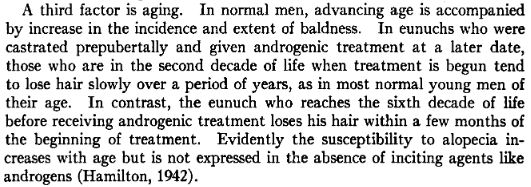
Nope, response to androgens does seem to change with age.

hamilton1951.png

(Hamilton, 1951)
 

jetlife1

Established Member
My Regimen
Reaction score
117
@InBeforeTheCure okay well my idea was quickly debunked lol however androgens and DHT do decrease with age so that could slow down progressive hair loss on its own.

Also, the castrated men who were given androgens in the sixth decade of life are most likely having "catch-up" hair loss similar to what happens after stopping finasteride after long term use.
 

InBeforeTheCure

Established Member
My Regimen
Reaction score
950
Thats so weird--what is it ? why?

Like most things on this subject, nobody knows. One possibility is that a developmental switch, independent of androgen exposure, changes gene expression, splicing patterns, and so on in hair follicle cells. Then when present, androgens trigger the miniaturization of the HF through interaction of AR (which may itself have higher expression) with these other factors. Facial hair growth may be the mirror case of this -- it's also androgen-dependent (and isn't usually reversed dramatically with anti-androgens), develops in a pattern over many years, with new vellus hairs turning terminal even after several years of androgen exposure. It would be interesting to know if older castrates also grow facial hair quicker when given androgens...or body hair, which is another similar case.

@InBeforeTheCure okay well my idea was quickly debunked lol however androgens and DHT do decrease with age so that could slow down progressive hair loss on its own.

Also, the castrated men who were given androgens in the sixth decade of life are most likely having "catch-up" hair loss similar to what happens after stopping finasteride after long term use.

Yep, the same mechanism could be at work after stopping finasteride, or even while taking finasteride if it isn't strong enough at a certain point to battle the ever increasing "androgen sensitivity".
 
Last edited:
Top