

- Reaction score
- 60
I imagine most people here have a head mount of some sort. I myself started with a small styrofoam head before upgrading to a 22" Gex head block on a tripod.
However, none of this stuff actually fit my head shape/system bases. It made it a bit difficult to do cut-ins and wash, condition and dye off-head. Now that I'm making and repairing systems, it's a must that I have a custom head block.
Pre-requisite: Create a full-head template
We all know how to make a template from tape and plastic wrap. In this case, you want a bigger, full-head template so you can shape a whole head block to it. Here's a video refresher on how to do it:
I wouldn't say you'd have to go down to where you're cutting out ear-holes, but probably just above the ear.
Head block creation options
There are two main ways you can create a custom head block. The first is to just take an existing Gex cork head block and add padding to shape it better. The second is to create a fully custom block out of liquid polyurethane expanding foam. The re-shaped Gex head block will be great for pinning a base for a cut-in/stying. The fully custom will be best for situations where you need perfect accuracy, such as creating repairing your own hair systems, or if you just want that extra accuracy and customization.
There is a third way, involving using plaster of paris instead of foam for filling the wig head. But IMO, foam will hold up longer from pinning and is easy to handle.
Option 1: Reshaping a padded cork head block
This video by WAM hair studio shows a great way to make the padded block.
In short, you put your full-head template over the head block and evaluate where the empty space is. You then take off the template, add some filler (napkin, cotton balls) followed by a layer of tape, and then put the template back on and re-evaluate.
Unlike the video, I personally used paper napkins instead of cotton balls as it's more dense and pads the head with less give. It may take a while, but you'll get there eventually, and you'll have it forever after.
(Photo attached down below.)
Option 2: Create a foam, fully accurate head block
This option will give you an unparalleled, fully accurate block of your head. First, you need to buy a commercial medium density liquid polyurethane expanding foam mixture, I bought this one here:
https://www.amazon.com/Liquid-Urethane-Rigid-Pour-Density/dp/B07L545RDN
This foam is much better quality than say, the "Good Stuff Expanding Foam" spray you get at Home Depot. Although that will work, it will leave more air gaps and you have to poke 50 holes all over the template to dry the interior. You don't need to do that with the 4b medium density mix, and it's much more substantial/durable.
Make sure your template is fairly strong, maybe add another layer of clear packing tape on the outside for reinforcement. It will be under pressure from the foam expansion. Lay the template upside-down and put a couple tape strips in each direction over the top, to ensure that the top lip doesn't expand out of shape as the foam is expanding.
Next mix the foam according to instructions. You want the air temperature to be in the 72F - 75F range. To mix, I used a clear plastic liner that you would buy at home depot for a hand-held paint bucket. You can use any disposable container that is at least a pint in capacity. Use a scale to measure the weight of each accurately as the ratio dictates (should be 1:1.15). Quickly mix it in the container and count to 45 seconds. Then immediately pour it into the mold, about halfway up. This should be enough for it to expand to the top. The foam will be HOT for about 10 minutes as it reacts and solidifies.
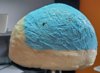
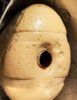
It would be wise to put some kind of "hole" in the top for a wig mount, as it's expanding. Try to keep it level and centered while the foam expands and solidifies around it. I used a small medicine bottle. Check out my pictures below to see the hole, and the finished product.
The next day, cut / peel off the template and you'll have a relatively smooth head block that should very accurately represent your head. I was able to put a previous template I made for my hair system design, and it fit perfectly on the head.
You'll probably want to paint over the top with a light blue acrylic waterbased paint, to give it a nice contrast to your hair and your lace colors. Finally, you can cover this with a layer of stretched plastic wrap to make it nice and clean. As a bonus, you can draw your template shape on top of that with a sharpie, and if you want to change that design later, just take off the plastic wrap and add a new sheet!
(Photo attached down below)
If you want to follow my picture updates of my Norwood 4 system in progress and other wigmaking info, follow me on Insta at @TheLoneWigMaker.
However, none of this stuff actually fit my head shape/system bases. It made it a bit difficult to do cut-ins and wash, condition and dye off-head. Now that I'm making and repairing systems, it's a must that I have a custom head block.
Pre-requisite: Create a full-head template
We all know how to make a template from tape and plastic wrap. In this case, you want a bigger, full-head template so you can shape a whole head block to it. Here's a video refresher on how to do it:
Head block creation options
There are two main ways you can create a custom head block. The first is to just take an existing Gex cork head block and add padding to shape it better. The second is to create a fully custom block out of liquid polyurethane expanding foam. The re-shaped Gex head block will be great for pinning a base for a cut-in/stying. The fully custom will be best for situations where you need perfect accuracy, such as creating repairing your own hair systems, or if you just want that extra accuracy and customization.
There is a third way, involving using plaster of paris instead of foam for filling the wig head. But IMO, foam will hold up longer from pinning and is easy to handle.
Option 1: Reshaping a padded cork head block
This video by WAM hair studio shows a great way to make the padded block.
In short, you put your full-head template over the head block and evaluate where the empty space is. You then take off the template, add some filler (napkin, cotton balls) followed by a layer of tape, and then put the template back on and re-evaluate.
Unlike the video, I personally used paper napkins instead of cotton balls as it's more dense and pads the head with less give. It may take a while, but you'll get there eventually, and you'll have it forever after.
(Photo attached down below.)
Option 2: Create a foam, fully accurate head block
This option will give you an unparalleled, fully accurate block of your head. First, you need to buy a commercial medium density liquid polyurethane expanding foam mixture, I bought this one here:
https://www.amazon.com/Liquid-Urethane-Rigid-Pour-Density/dp/B07L545RDN
This foam is much better quality than say, the "Good Stuff Expanding Foam" spray you get at Home Depot. Although that will work, it will leave more air gaps and you have to poke 50 holes all over the template to dry the interior. You don't need to do that with the 4b medium density mix, and it's much more substantial/durable.
Make sure your template is fairly strong, maybe add another layer of clear packing tape on the outside for reinforcement. It will be under pressure from the foam expansion. Lay the template upside-down and put a couple tape strips in each direction over the top, to ensure that the top lip doesn't expand out of shape as the foam is expanding.
Next mix the foam according to instructions. You want the air temperature to be in the 72F - 75F range. To mix, I used a clear plastic liner that you would buy at home depot for a hand-held paint bucket. You can use any disposable container that is at least a pint in capacity. Use a scale to measure the weight of each accurately as the ratio dictates (should be 1:1.15). Quickly mix it in the container and count to 45 seconds. Then immediately pour it into the mold, about halfway up. This should be enough for it to expand to the top. The foam will be HOT for about 10 minutes as it reacts and solidifies.
It would be wise to put some kind of "hole" in the top for a wig mount, as it's expanding. Try to keep it level and centered while the foam expands and solidifies around it. I used a small medicine bottle. Check out my pictures below to see the hole, and the finished product.
The next day, cut / peel off the template and you'll have a relatively smooth head block that should very accurately represent your head. I was able to put a previous template I made for my hair system design, and it fit perfectly on the head.
You'll probably want to paint over the top with a light blue acrylic waterbased paint, to give it a nice contrast to your hair and your lace colors. Finally, you can cover this with a layer of stretched plastic wrap to make it nice and clean. As a bonus, you can draw your template shape on top of that with a sharpie, and if you want to change that design later, just take off the plastic wrap and add a new sheet!
(Photo attached down below)
If you want to follow my picture updates of my Norwood 4 system in progress and other wigmaking info, follow me on Insta at @TheLoneWigMaker.
Attachments

Last edited: